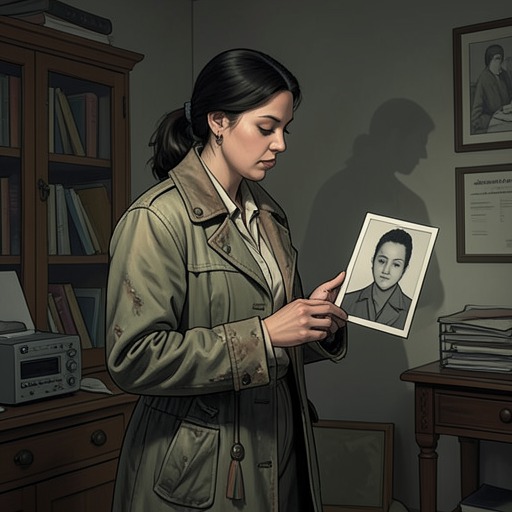
Kendra Rae reveals Wagner’s past to Shani
The Other Black GirlKendra Rae Phillips’s disclosure to Shani Edmonds links her defiance of the publishing industry’s expectations to the unexplained changes affecting Black women, and points suspicion toward Richard Wagner and Diana Gordon. A newspaper clipping gives the conversation a material record of Kendra’s past; her account of what happened to her and her friendship with Diana turns that record into a warning Shani feels compelled to carry to Nella Rogers.
The Meeting and Its Immediate Stakes
Lynn Johnson introduces the silver-haired woman as someone Shani Edmonds and she have finally met, but Kendra Rae Phillips corrects her: they have not actually been introduced. Shani offers her hand and gives her name; Kendra responds with her full name. Recognition then floods Shani’s face. She is embarrassed by how visibly startled she is, and asks what Kendra is doing there. Kendra’s reserved expression gives way to a dazzling grin, and Shani grins back. The response reassures Shani that Kendra is not offended by her astonishment; the encounter begins with the recognition of a famous figure, but quickly becomes an exchange Kendra is willing to lead.
Kendra draws a newspaper article and a notebook from a small patchwork bag. She explains that Lynn Johnson contacted her with interesting information and says she has come to tell them about her time at Wagner Books. Before recounting that history, however, she turns directly to Shani and asks what she saw Hazel-May McCall give Nella Rogers at Curl Central. That question makes the meeting more than an account of Kendra’s past: Kendra is also seeking Shani’s firsthand observation of a recent event involving Nella and Hazel-May McCall. The information moves in both directions, with Lynn’s contact bringing Kendra into the room and Shani’s answer positioned as necessary context for what Kendra is about to disclose.
The Clipping and Kendra’s Defiance
Kendra’s newspaper clipping preserves a statement from an interview in which she rejected the expectation that she should work with white writers. She objected to white scholars explaining Black history and culture, naming the Great Migration, Miles, and Black New Year’s food traditions as subjects for which she did not need their authority. Shani reads the statement aloud while Kendra takes a copy of Burning Heart from the shelf and turns its pages with a short, unpainted index fingernail. The scene sets the public record of Kendra’s refusal beside a book associated with her work, while her attention remains on the volume as Shani finishes reading.
The clipping is brown and faded enough that Shani fears it may fall apart in her hands. Its fragile condition contrasts with the force of the statement it records. Shani asks whether the words were taken out of context. Kendra answers that they were not, without looking up from the book. Her response leaves the statement standing rather than qualifying it: the confrontation with an industry organized around white authority was deliberate. Shani regards Kendra’s candor as an extraordinary act of self-definition, particularly because Kendra made it as her star was rising. In Shani’s understanding, Kendra’s refusal to perform the expected role of a Black woman in a predominantly white industry is both the source of her defiance and the act that made her vulnerable to punishment.
From Personal History to Suspected Conspiracy
Kendra connects her experience to the change she believes is happening to Black women. She suspects that Imani, a childhood friend of Diana Gordon and Kendra, was changed too. Kendra identifies Richard Wagner as the person she suspects: in her view, he is the only explanation she can find for why Diana would try to do the same thing to her and then avoid being seen with her in public after Kendra’s interview. Her explanation is presented as a suspicion, not confirmed proof, but it gives Shani a possible link between the transformation and the publishing world.
Lynn Johnson supplies the institutional connections that make Kendra’s suspicion more troubling to Shani. Richard Wagner was Kenny’s boss and is now Nella Rogers’s boss. Lynn has also noticed how frequently Richard appears at Diana Gordon’s functions and in Diana’s acknowledgments. Those repeated appearances had made Lynn sense a connection between them before Kendra named Richard as her suspected cause. Shani is startled by the possibility that the danger extends beyond Hazel-May McCall: she begins to wonder whether Richard and Diana are involved, and whether her own bosses had a hand in what happened at Cooper’s. The conversation therefore revises Shani’s understanding of the threat from an individual encounter into a possible network of relationships around her.
Friendship, Distrust, and the Warning to Nella
Shani asks why Diana would do this, given that Kendra had called her a best friend. Kendra’s eyes provide Shani with an answer to the emotional question even though the details of Diana’s attempt remain unexplained: Shani understands that Kendra sees her former closest friend as having committed an ultimate betrayal. The pain is sharpened by Shani’s own memory of Diana’s fiction. She has read one of Diana’s earlier novels, a moving story about Black friendship across forty years, and it once made her cry on a bus. The contrast between that literary tenderness and Kendra’s account makes the suspected betrayal harder for Shani to reconcile, not easier to dismiss.
The disclosure also exposes a strain between Shani and Lynn Johnson. Hurt that Lynn had not told her what she knew, Shani says she had thought Lynn did not trust her. Lynn replies that the information was being shared on a need-to-know basis and that Shani needs to know now. Shani turns back to Kendra and asks whether they think Richard Wagner has been behind all of it. Kendra says the possibility would not surprise her. The exchange does not establish Richard’s guilt, but it gives Shani a reason to take the danger seriously while leaving her unsettled about how much of the wider picture remains concealed.
Afterward, Shani is walking toward Joe’s when a truck honks at a delivery worker who has strayed from the bike lane. She looks up and realizes she has reached 100th Street without noticing; the warning and its implications have absorbed her attention. She feels sick and afraid, imagining that Lynn Johnson might one day arrive at Joe’s already changed and wondering whether she would recognize it. That fear converts Kendra’s history into an immediate obligation. Shani decides she cannot watch another person undergo the change without acting and must tell Nella Rogers. Lynn’s admission that Shani had not been trusted remains part of the decision: Shani leaves the conversation with both a warning to pass on and unresolved doubts about the people from whom she has just learned it.